Sections





Latest News

Die-Cut vs. Waterjet Cut Silicone Gaskets
What’s the best choice for your production run? Selecting the right material is critical for manufacturing high-performance seals, but how...


Rolling Stock Networking: Connect with CB Frost at RSN 2026
At CB Frost & Co, we don’t believe in waiting around when a great opportunity knocks. That is exactly why...
Useful links


© 2024 CB Frost • All Rights Reserved • A Bluechilli Website
Sponge
Sponge
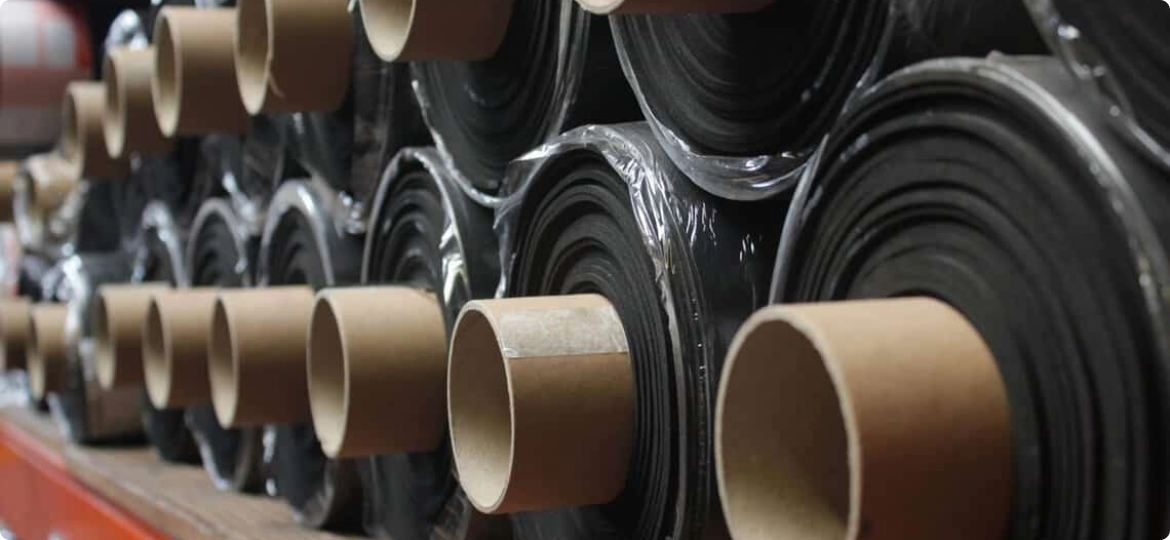
An Introduction to CB Frost’s Sponge Rubber
As a market leader in supplying sponge, foam, and rubber materials for a wide range of industrial sectors, CB Frost are committed to staying ahead of the curve when it comes to innovation. Here at CB Frost we supply a wide array of sponge rubber products: Neoprene, EPDM, PVC, General Purpose Silicone, Semi-Closed Cell EPDM, CBF Sil V0 Silicone, LSLT (Low Smoke Low Toxicity) Neoprene.
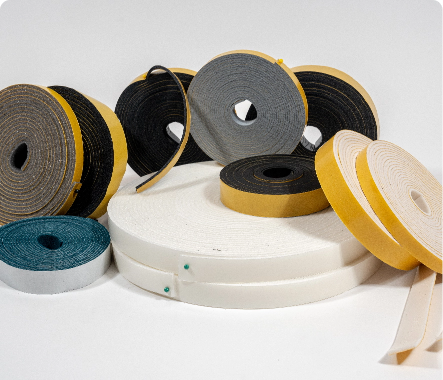
What is Sponge Rubber?
Sponge rubber is made of neoprene, EPDM, nitrile, silicone, and many other elastomeric materials. Often, sponge rubber profiles are fabricated into finished gaskets that are used for shock absorption and provide good compression and recovery.
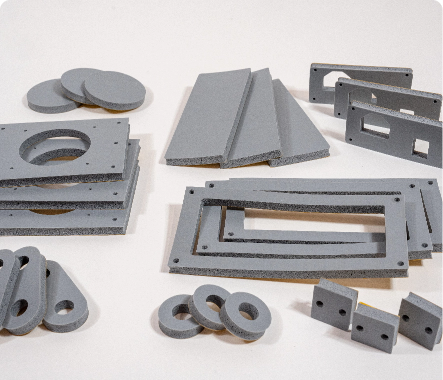
Why use Sponge Rubber?
Sponge rubber is a commonly used gasket material that can be specified for a range of applications, including low pressure pipe seals and weather strips. It is also used in radiators, garden and appliance hose, tubing, pond liners, washers, solar panel heat collectors and speaker cone surrounds. It is also commonly used in vehicles, notably in door and window seals.
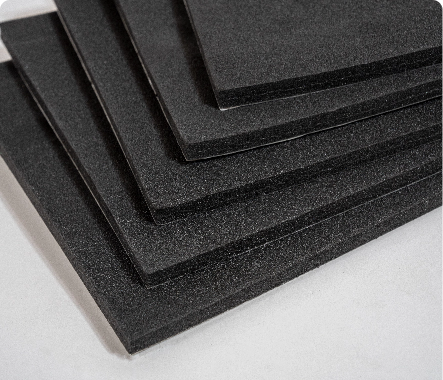
Advantages of Sponge Rubber?
Sponge rubber has many advantages including good UV resistance, durability for cost, good mechanical properties, a wide temperature range, outstanding weather resistance and strong durability.
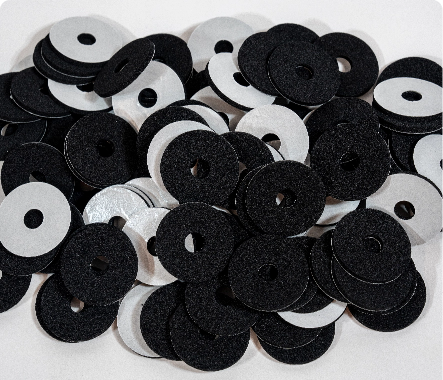
Disadvantages of Sponge Rubber?
Sponge rubber has disadvantages including its sturdiness and lifespan when compared to non-biodegradable materials.
Our lightweight CBF Sil-V0 silicone sponge is fully closed cell and has been formulated to improve fire, smoke and safety for the rail industry.
CBF Sil-V0 is compliant with the European fire safety standard EN45545-2 for rail vehicles (more information can be found in the table below). CBF Sil-V0 can be supplied as extruded sponge profiles. Typical applications include LED lighting, door seals, gap fillers, LCD gaskets and HVAC.
no Download CBF Sil V0 - soft meduim
CBF-Sil V0 Silicone Sponge Thicknesses
2mm, 3mm, 4mm, 5mm, 6mm As Standard
| Fire Classification | |
|---|---|
| EN45545-2 | |
| R22 – Interior Seals | HL3 |
| R23 – Exterior Seals | HL3 |
| UL 94 | V-0 |
| Specification | Typical Values |
|---|---|
| Polymer: | Silicone |
| Structure: | Closed Cell |
| Colour: | Grey |
| Density: | 300 kg/m3 (Soft-Medium) |
| Temp: | -60/+230 °C |
General Characteristics:
| Test | Result | Standard |
|---|---|---|
| Brittle Point | -80°C (-112 °F) | ASTM D746 |
| Volume Resistivity | 3.89 x 10¹⁴ | ASTM D257 |
| Dielectric Strength | 6.06 kV/mm | ASTM D 149 |
Mechanical Properties:
| Property | Units | CBF Sil V-0 Soft-Medium |
Test Method |
|---|---|---|---|
| Density (*Measured on 12.7mm sheet) |
Kg/m⁻³ lb.ft⁻³ |
300 19.4 |
ISO 845 ASTM D1056 |
| Compression Force Deflection 25% strain |
kPa psi |
40 5.8 |
ASTM D1056 |
| Compression Force Deflection 40% strain |
kPa psi |
90 13 |
ISO 3386 part 1, 2 |
| Tensile Strength | kPa psi |
304 44 |
ISO 1798 ASTM D412 |
| Elongation at failure | % | 90 | ISO 1798 ASTM D412 |
| Compression Set 50% compression 24 hours recovery. 22 hours @ 70 °C (158°F) |
% | <1 | ISO 1856 |
| 22 hours @ 100°C (212 °F) | % | 3 | ASTM D1056 |
| Thermal conductivity | W/m.K | 0.099 | DIN EN993-15 |
| Water Absorption | % | <1 | ASTM D1056 |
Standard Capabilities *Other sizes available on request
| Thickness mm (inches) | Width mm (inches) | Length M (ft) |
|---|---|---|
| 2mm – 12mm (0.078″-0.472″) | 1000mm (39″) | 5m (16.5ft) |
| >12mm – 15mm (>0.472″-0.590″) | 1000mm (39″) | 5m (16.5ft) |
| >15mm – 25mm (>0.590 – 1.0″) | 1000mm (39″) | 1m (3.2ft) |
**Data as per our current stock grade
Overview:
Manufacturing Capabilities:
Gaskets

Strip
Washers
Sheeting
Cord
Fabrication
Extrusion
General purpose closed cell silicone sponge delivers high performance and long-life span in extreme Ozone/UV environments
General purpose closed cell silicone sponge delivers high performance and long-life span in extreme Ozone/UV environments and has a wide temperature range from -60°C to 230°C, which makes it the ideal material choice in applications where environmental conditions are unstable or volatile.
Our closed cell silicone sponge can be widely used as gaskets and seals in outdoor and indoor applications, i.e. HVAC units, lighting systems and electrical enclosures.
Availability
- Sheeting supplied in rolls up to 1000mm wide or individual sheets of 1 meter x 2 meters
- Pressure sensitive adhesive backing
- Punched and Water Jet gaskets
- Standard Colours – White, Black, Red Iron Oxide (RIO)
Typical Applications
- Automotive, Electronics, Energy, Construction, Heating & Ventilation (HVAC), Industrial, Insulations, Lighting and Marine.
Silicone Sponge Thicknesses
1.5mm, 2mm, 3mm, 5mm, 6mm, 8mm 10mm And 12mm As Standard
| Specification | Typical Values |
|---|---|
| Polymer: | Silicone |
| Structure: | Closed Cell |
| Colour: | White/Black/Red Iron Oxide (RIO) |
| Density: | 250 kg/m3 |
| Temp: | -60/+230 °C |
Physical
| PROPERTY | UNITS | GP200 | GP250 | GP350 | GP400 | GP450 | GP530 | TEST METHOD |
|---|---|---|---|---|---|---|---|---|
| Density | kg/m³ lb.ft⁻³ |
180 11.2 |
235 14.6 |
300 18.7 |
400 25.0 |
440 27.5 |
515 32.0 |
ISO 845 ASTM D1056 |
| Hardness | Shore 00 Shore A |
35 ±5 <5 |
40 ±5 5 |
50 ±5 13 |
65 ±5 17 |
70 ±5 24 |
80 ±5 30 |
ASTM D2240 |
| Compression Stress 40% strain Compression Stress 25% strain |
kPa
psi |
50
3.0 |
80
5.0 |
105
7.0 |
165
11.0 |
220
14.5 |
380
25.0 |
ISO 3386 ASTM D1056 |
| Tensile Strength | MPa psi |
0.6 87 |
0.6 87 |
0.75 108 |
0.75 108 |
1.5 217 |
2.0 290 |
ISO 1798 ASTM D412 |
| Elongation to failure |
% | 140 | 145 | 120 | 120 | 130 | 130 | ISO 1798 ASTM D412 |
| Compression Set 50% compression 24hrs recovery 22hrs @ 70°C (158°F) |
% | 14.0 | 6.0 | 2.0 | 2.0 | 1.0 | 1.0 | ISO 1856 |
| 22hrs @ 100°C (212°F) |
% | 36.0 | 12.0 | 5.0 | 4.0 | 2.0 | 2.0 | ASTM D1056 |
| Water absorption | <5% | <5 | <5 | <5 | <5 | <5 | 2 | ASTM D1056 |
General Characteristics
| Test | Typical Value | Standard | |||||
|---|---|---|---|---|---|---|---|
| Value 1 | Value 2 | Value 3 | Value 4 | Value 5 | Value 6 | ||
| Brittle Point | -80°C (112°F) |
-80°C (112°F) |
-80°C (112°F) |
-80°C (112°F) |
-80°C (112°F) |
-80°C (112°F) |
ASTM D746 |
| Limiting Oxygen Index | 24% | 24% | 24% | 24% | 24% | 24% | BS 2782 Part 1 |
| Thermal Conductivity | 0.064 W.m- 1.K-1 |
0.070 W.m- 1.K-1 |
0.078 W.m- 1.K-1 |
0.095 W.m- 1.K-1 |
0.102 W.m- 1.K-1 |
0.117 W.m- 1.K-1 |
BS 874 Part 2 |
| Radiation Resistance | >10⁵ Grays (107 Rads) typical |
>10⁵ Grays (107 Rads) typical |
>10⁵ Grays (107 Rads) typical |
>10⁵ Grays (107 Rads) typical |
>10⁵ Grays (107 Rads) typical |
>10⁵ Grays (107 Rads) typical |
– |
**Data as per our current stock grade
Overview:
Manufacturing Capabilities:
Gaskets
Strip
Washers
Sheeting
Cord
Fabrication
Extrusion
Neoprene sponge is a closed cell synthetic rubber with similar properties to EPDM and Natural sponge in terms of its resilience and resistance to abrasion.
Due to its chemical inertness, it is a well-suited material for industrial applications such as being made into gaskets for protection against dust and moisture.
Neoprene sponges have good resistance to oils, whereas resistance to petrol and other hydrocarbons is more moderate. Depending on the grade of material, Neoprene sponge can withstand temperatures of as low as -40˚C and as high as 75˚C.
no Download CF2 -1413 Datasheet
Neoprene Sponge Thicknesses
1.5mm, 2mm, 3mm, 5mm, 6mm, 8mm 10mm, 12mm, 16mm, 20mm, 25mm, 30mm And 40mm As Standard
| Specification | Typical Values |
|---|---|
| Polymer: | CR |
| Structure: | Closed Cell |
| Colour: | Black |
| Density: | 115-155 kg/m3 |
| Temp: | -40/+75 °C |
Physical
| Property | Standard | Value | Unit |
|---|---|---|---|
| ASTM D1056-14 Classification | 2C2 B3 M | – | – |
| Density | ASTM D3575 | 115-155 | Kg/m3 |
| Compression Deflection (25%) | ASTM 1056 | 20-40 | kPa |
| Compression Deflection (50%) | ASTM 1056 | 50-70 | kPa |
| Compression Set (25%/22h/23°C)-After 24hrs | ASTM 1056 | 2-4 | % |
| Compression Set (50%/22h/23°C)-After 24hrs | ASTM 1056 | 15-35 | % |
| Shrinkage (22h/70°C) | ASTM D573 | 8-12 | % |
| Shore Hardness | – | 40-45 | 00 |
| Elongation | ASTM D412 | 180-220 | % |
| Temperature Range (Constant) | – | -40/+75 | °C |
| Temperature Range (intermittent) | – | +90 | °C |
| Water Absorption (Max Weight Change) | ASTM D1056 | 1-3 | % |
| Tensile Strength | ASTM D412 | 480-530 | kPa |
| Flame Resistance (>3mm) | UL94 HF1 | Pass | – |
| Environmental Protection | – | CFC & HCFC FREE | – |
**Data as per our current stock grade
Overview:
Manufacturing Capabilities:
Gaskets
Strip
Washers
Sheeting
Cord
Fabrication
Extrusion
CB Frost now stock a closed cell pure Neoprene sponge (EN45545-2) to complement our range of fire safe materials.
LSLT (low smoke, low toxicity) Neoprene sponge is a fully closed cell and available in a selection of thicknesses, see table below.
LSLT Neoprene sponge has been formulated to comply with the European fire safety standard EN45545-2 for rail vehicles.
no Download LSLT Neoprene Sponge (EN45545-2) Datasheet
LSLT Neoprene Sponge (EN45545-2) Thicknesses
3mm, 4mm, 5mm, 6mm, 7mm, 8mm, 9mm, 10mm ,12mm, 13mm, 15mm, 16mm, 18mm, 22mm And 25mm As Standard
| Fire Classification | |
|---|---|
| EN45545-2 (R22) | HL1 |
| EN45545-2 (R23) | HL2 |
| UL 94 | HF-1 |
| Specification | Typical Values |
|---|---|
| Polymer: | CR |
| Structure: | Closed Cell |
| Colour: | Black |
| Density: | 140 kg/m3 |
| Temp: | -50ºC/+110ºC |
Technical Data
| TECHNICAL DATA | TEST METHOD | RESULTS |
|---|---|---|
| BASE | – | CHLOROPRENE |
| Density | ISO 845 | 140 +/- 30Kg/m3 |
| Classification | ASTM D1056-07 NFR 99211 |
2C2 3C 08 B3 |
| Hardness | Shore C Shore 00 |
22 +/-5 55 +/-5 |
| Compression deflection 25% | ISO 3386 | 35 – 65 kPa |
| Compression deflection 50 % | ISO 3386 | 80 – 160 kPa |
| Compression Set 50%, 24H, 23°C | ISO 815-1 | <25% |
| Tensile Strength | ISO 1798 | >300 kPa |
| Elongation to Break / Rupture | ISO 1798 | >155% |
| Water Absorption | ISO 6916 | <5% |
| Flammability | UL 94 | HF-1 (File n°: QMFZ2.E350291) |
| Fire – Smoke – Toxicity | EN45545-2 | HL1/HL2/HL3 with exception (See results on page 2) |
| Smoke Opacity | ASTM E 662 | Pass |
| Gas Emission | BSS 7239 | Pass |
| Dielectric Rigidity | NF ISO-EN-CEI C26-225 |
>10482.2 kV/cm (No breakdown at 5kV) |
| Ozone resistance | ISO 1431-1 | No Cracking |
| Resistance AIR + UV | – | Good |
| Temperature range | Constant Intermittent |
-50° +110°C +120°C |
| Environmental Protection | – | Recyclable CFC & HCFC free REACH – RoHS IMDS available |
| Storage conditions | – | To be stored in a well-ventilated place at room temperature |
Summary of Results
| Standard | Parameter (unit) |
Maximum / Minimum |
HL1 | HL2 | HL3 | Obtained results |
Reached HL |
Test report |
|---|---|---|---|---|---|---|---|---|
| EN ISO 4589-2 |
OI (%) | Min | 28 | 28 | 32 | 30 | HL1, HL2 | P194920 – DEC/2 |
| EN SO 5659-2 25 kw/m2 |
Dsmax | Max | 600 | 300 | 150 | 46.3 | HL1, HL2, HL3 |
P194920 – DEC/1 |
| NF X70-100-1 NF X70-100-2 |
ITCPNL | Max | 1.2 | 0.9 | 0.75 | 0.99 | HL1 | P |
Summary of Results
| Standard | Parameter (unit) |
Maximum / Minimum |
HL1 | HL2 | HL3 | Obtained results |
Reached HL |
Test report |
|---|---|---|---|---|---|---|---|---|
| EN ISO 4589-2 |
IO (%) | Min | 28 | 28 | 32 | 29.5 | HL1, HL2 | P194920 – DEC/2 |
| EN SO 5659-2 25 kw/m2 |
Dsmax | Max | – | 600 | 300 | 46.3 | HL1, HL2, HL3 |
P194920 – DEC/1 |
| NF X70-100-1 NF X70-100-2 |
ITCPNL | Max | – | 1.8 | 1.5 | 0.99 | HL1, HL2, HL3 |
P194920 – DEC/3 |
**Data as per our current stock grade
Overview:
Manufacturing Capabilities:
Gaskets
Strip
Washers
Sheeting
Fabrication
EPDM sponge (Ethylene Propylene Diene Monomer) is a closed cell sponge material that is ideally suited for use in outdoor and automotive applications. The main properties of EPDM sponge are its excellent resistance to ozone, UV, and weathering, as well as its general resistance to abrasion.
With a temperature range of between -40°C and 80°C (depending on the grade of sponge), EPDM is ideal for use in sealing outdoor applications to give dust and moisture protection.
Whilst normally manufactured black, we can also produce EPDM sponge in white.
EPDM sponge is manufactured in block form in a wide range of different densities and specifications. In stock we hold a range of thicknesses from 1.5mm to 30mm, in 10Mtr long x 1Mtr wide rolls (subject to thickness) ready for use in a wide range of applications
no Download CF3 - 2010 Datasheet
EPDM Sponge Thicknesses
1.5mm, 2mm, 3mm, 5mm, 6mm, 8mm 10mm ,12mm, 16mm, 20mm, 25mm And 30mm As Standard
| Specification | Typical Values |
|---|---|
| Polymer: | EPDM |
| Structure: | Closed Cell |
| Colour: | Black |
| Density: | 100-140 kg/m3 |
| Temp: | -40/+80 °C |
Physical
| Property | Standard | Value | Unit |
|---|---|---|---|
| ASTM D1056-14 Classification | 2A2 B3 M | – | – |
| Density | ASTM D3575 | 100-140 | Kg/m3 |
| Compression Deflection (25%) | ASTM 1056 | 30-50 | kPa |
| Compression Deflection (50%) | ASTM 1056 | 60-80 | kPa |
| Compression Set (25%/22h/23°C)-After 24hrs | ASTM 1056 | 7-11 | % |
| Compression Set (50%/22h/23°C)-After 24hrs | ASTM 1056 | 20-40 | % |
| Shrinkage (22h/70°C) | ASTM D573 | 10-15 | % |
| Shore Hardness | – | 35-40 | 00 |
| Elongation | ASTM D412 | 150-200 | % |
| Temperature Range (Constant) | – | -40/+80 | °C |
| Temperature Range (intermittent)) | – | +90 | °C |
| Water Absorption (Max Weight Change) | ASTM D1056 | 1-2 | % |
| Tensile Strength | ASTM D412 | 390-450 | kPa |
| Environmental Protection | – | CFC, Halogen & HCFC Free |
– |
| Flame Resistance (>3mm) | FMVSS302 | Pass | – |
**Data as per our current stock grade
Overview:
Manufacturing Capabilities:
Gaskets
Strip
Washers
Sheeting
Cord
Fabrication
Extrusion
PVC sponge is a low density closed cell sponge, 100-120kg/m3 available in two forms: slow or fast recovery.
Ideal applications for PVC closed cell sponge include saddles, expansion joints, desk pads and as insulation on panels.
no Download CF15 -812 Datasheet
PVC Sponge Thicknesses
3mm, 4mm, 5mm And 6mm As Standard
| Specification | Typical Values |
|---|---|
| Polymer: | PVC |
| Structure: | Closed Cell |
| Density: | 100-120 kg/m3 |
| Temp: | -30/+60 °C |
| Property | Unit | Value | Test Method |
|---|---|---|---|
| Density | kgs/m3 | 100-125 | – |
| Tensile Strength | kpa | >150 | DIN 53571 |
| Elongation at break | % | >120 | DIN 53571 |
| Tear Strength | N/mm | >0.7 | DIN 53515 |
| Compression Set | % | <20 | DIN 53572 |
| Compression Deflection | kpa | 0s 2-12 60s 2-7 |
ASTM 1667 |
| Shore 00 Hardness | – | 7-30 | – |
| Water Absorption | % | – | – |
| Compression Waterseal | – | >90% | U-TEST |
| Flammability | mm/min | <100 >6mm |
FMVSS302 |
| Temperature Range | deg C | -30 / +60 | – |
**Data as per our current stock grade
Overview:
Manufacturing Capabilities:
Gaskets
Strip
Washers
Sheeting
Unlike standard EPDM sponge, Nitto EPDM super soft (Ethylene Propylene Diene Monomer) is a semi closed cell sponge.
This means that it contains a mixture of both open and closed cells, giving the sponge the flexibility to compress more easily.
Due to the properties of Nitto EPDM super soft sponge and other EPDM materials, it is ideally suited for use in outdoor and automotive applications. Nitto EPDM semi closed cell sponge exhibits impressive ozone, UV, weather, and general resistance as well as withstanding a temperature range of between -40 ˚C and 135˚C.
Nitto EPDM super soft sponge is a model solution to sealing outdoor applications, to protect against dust and moisture.
no Download CF22 -EE1010 Datasheet
Nitto Semi-Closed EPDM Sponge Thicknesses
3mm, 5mm, 10mm, 20mm And 25mm As Standard
| Specification | Typical Values |
|---|---|
| Polymer: | EPDM |
| Structure: | Semi-Closed Cell |
| Colour: | Black |
| Density: | 95 kg/m3 |
| Temp: | -40/+135 °C |
Physical
| Test | Test Method | Unit | Value |
|---|---|---|---|
| Thickness | ISO 1923 | mm | 3 to 30mm |
| Density | ISO 845 | Kg/m3 | 95 |
| Elongation | JIS K 6767 | % | 430 |
| Tensile Strength | JIS K 6767 | kPa | 90 |
| 50% Compression load | Nitro Europe test method | kPa | 5 |
| Water absorption (50%) | Nitro Europe test method | % | 3.1 |
| Water tightness (75%) | Nitro Europe U-shape method | – | No leakage |
| Flammability (ref. 10mm) | FMVSS 302 | mm/min. | < 100 |
| Weatherability (after 1080 hours, 63°C, 12mm./60mm, water spray, test performed on stretched foam elongated to 30%) |
Sunshine weatherometer | – | No cracks |
| Temperature Resistance | Dimensional stability | – | -40 to 135°C |
| Chemical Resistance (acid 1%H2SO4, alkaline 1%NaOH) |
Immersion at 20°C for 7 days | – | Stable |
| Ozone Resistance (75 ppm ozone, 40°C, 30 days, 20% elongated) |
Visual inspection | – | No cracks |
| Watertightness (65%) | Nitto U-shape method | – | No leakage |
**Data as per our current stock grade
Overview:
Manufacturing Capabilities:
Gaskets
Strip
Washers
Sheeting
Fabrication