Sections

Latest News

News 4 Aug 2026

Die-Cut vs. Waterjet Cut Silicone Gaskets

What’s the best choice for your production run? Selecting the right material is critical for manufacturing high-performance seals, but how...

News 23 Jun 2026

Rolling Stock Networking: Connect with CB Frost at RSN 2026

At CB Frost & Co, we don’t believe in waiting around when a great opportunity knocks. That is exactly why...

Sponge Rubber Extrusions: The Unsung Heroes of Vibration Isolation and Noise Control

sponge rubber extrusions

In the world of industrial manufacturing and product design, there are certain materials and products that play pivotal roles yet seldom receive the spotlight they deserve. Among these, sponge rubber extrusions stand out as unsung heroes of vibration isolation and noise control in many different industries.

Often hidden away in the crevices of machinery, buildings, and vehicles, sponge rubber extrusions serve as a critical component in enhancing performance, safety and comfort. Closed cell rubber sponge materials including Silicone, EPDM, and Neoprene sponge are engineered to absorb and dampen the vibrations and noise that can degrade equipment functionality, or create harmful or uncomfortably loud environments. 

Let’s delve into the unique properties of sponge rubber extrusions and explore how they contribute to making our world a quieter, more comfortable place.

Sponge Rubber Extrusions

The sponge extrusion process is a manufacturing technique used to produce continuous profiles of sponge rubber materials with varying shapes and sizes. Raw materials are prepared and fed into an extruder, equipped with a heated barrel and rotating screw. As the material moves through the barrel, it is heated and pressurised to become more malleable. The screw forces the compound through a die at the end of the barrel, shaping the material into a length of a continuous profile that can then be cured cut and finished to create products to suit applications in industries ranging from automotive and rail, to construction, particularly noise and vibration isolation, along with insulation and sealing.

The extrusion process’s ability to produce parts with specific characteristics, such as flexibility, resilience, and resistance to environmental factors, makes it indispensable for creating components that meet the exacting requirements of so many modern applications.

Vibration Isolation and Noise Control

Sponge rubber extrusions play a crucial role in vibration isolation and noise control due to their unique material properties and design versatility. Here are some of the main reasons why they are so important, along with the benefits they provide in isolating vibrations and insulating against noise:

Material Properties

  • Elasticity: Sponge rubber’s elasticity allows it to absorb and dissipate energy, making it highly effective at isolating vibrations. This property ensures that it can return to its original shape after compression, maintaining its effectiveness over time.
  • Damping Characteristics: It has inherent damping properties, meaning it can absorb vibration energy and reduce the amplitude of vibrations. This is important for protecting machinery, vehicles and structures from the damaging effects of excessive vibration.

Versatility in Applications

Sponge rubber extrusions can be customised into various shapes and sizes, making them suitable for a wide range of applications. They can be fitted into or around machinery, between structural elements, or within products to reduce vibration and noise in multiple contexts, from industrial machinery to automotive components and building construction.

Noise Reduction

  • Sound Absorption: The porous structure of sponge rubber makes it excellent for absorbing sound waves to reduce noise levels. This is beneficial in environments where noise reduction is essential for comfort and safety, such as in residential buildings, offices, and vehicles. For example, noise reduction gaskets help to make rail travel more comfortable.
  • Sound Insulation: Sponge rubber extrusions can act as an insulating barrier, preventing the transmission of sound from one area to another. This makes them ideal for use in walls, flooring, and ceilings as part of construction projects aimed at creating quieter indoor environments.

Vibration Isolation

  • Protecting Equipment: By isolating vibrations, sponge rubber extrusions protect sensitive equipment from damage and wear. This extends the lifespan of machinery and electronics by preventing the harmful effects of continuous vibration.
  • Improves Accuracy: In precision applications, such as in laboratories or manufacturing facilities, reducing vibration is crucial for the accuracy and reliability of equipment. Sponge rubber extrusions help maintain stable conditions, ensuring precise measurements and operations.

Durability and Resistance

Sponge rubber materials can be formulated to be resistant to various environmental factors, including temperature extremes, UV light, water, and chemicals. This durability ensures that it remains effective as a vibration isolator and noise insulator, even in harsh conditions.

Energy Absorption

The ability of sponge rubber to absorb energy not only aids in vibration damping but also in impact protection. This makes it suitable for use in areas where shock absorption is necessary to protect components or individuals.

Improved Comfort and Safety

In the automotive industry and building construction, the use of sponge rubber extrusions contributes to improved comfort by reducing the transmission of noise and vibrations. This enhances the overall user experience and can also reduce fatigue in environments where noise and vibration are constant factors.

Rubber Extrusion Manufacturers

By integrating sponge rubber extrusions into the design of products and structures, manufacturers and engineers can achieve significant improvements in vibration isolation and noise control. These benefits are essential for protecting equipment, extending product lifespans, ensuring precision in sensitive applications, and enhancing comfort and safety in various environments.

At CB Frost, we supply custom made sponge and rubber extrusions in a wide range of materials to suit practically any vibration or noise control application. With our expertise in synthetic rubbers, sponge and plastics, we help customers in various sectors to select the best suited material to accommodate the processes and conditions they will be exposed to. With our extensive stock of rubber and sponge sheet materials and inhouse manufacturing capabilities, we can provide fast lead times.

To discuss your sponge rubber extrusion needs, contact our knowledgeable sales team.

CB Frost in 2022: Electric Vehicles and More

As we enter the new year, it provides an ideal opportunity to reflect on the events of the year that just passed. Whilst 2020 and 2021 saw us face certain restrictions as a result of COVID-19 as businesses in all industries continued to face the long term effects of the pandemic, 2022 was a year that saw CB Frost enter new markets such as electric vehicles, along with winning new contacts in existing markets.

Let’s look at some of what we achieved in 2022, along with some of the key topics we covered in our blog posts.

Entering the Electric Vehicles Market

ev battery

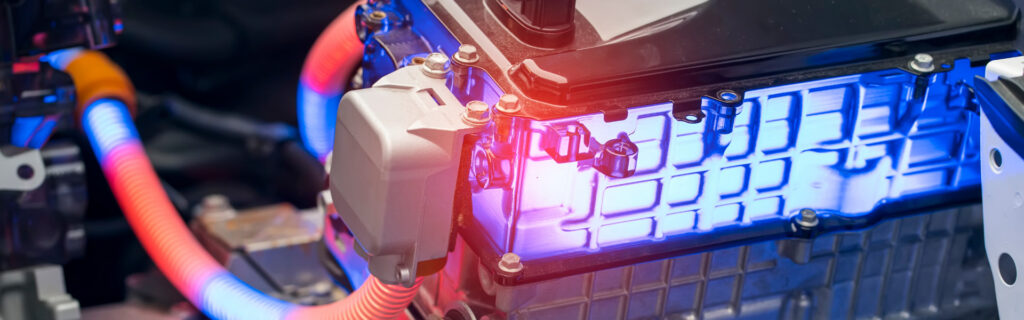
With the number of electric (EV) and hybrid (HEV) vehicles on the road rapidly increasing, in 2022 we teamed up with Rogers’ Corporation to supply a range of products for Lithium-ion battery packs for EV and HEV vehicles. With access to Rogers’ range of specialist materials for EV batteries, combined with our expertise in manufacturing, we have been able to develop high performance products for applications including 

  • Pressure management pads
  • Battery housing seals
  • Cooling plate spring pads
  • Manual service disconnect seals
  • Thermal runaway protection pads
  • Anti vibration and cushioning pads

With the return of trade shows and expos in a physical capacity, we were excited to showcase Rogers’ Corporation’s range of PORON® polyurethanes and BISCO® silicone materials, along with our range of EV battery components. Two key events we attended included the Battery tech Expo at Silverstone, and the Battery Cell and Systems, and Vehicle Electrification Expos at the NEC, Birmingham.

Attending these events provided our team with the chance to explore the scope of battery technology innovations, along with making new contacts and discussing our own range of materials and EV battery products.

Supporting the Ministry of Defence

CB Frost have long been a supplier to the Ministry of Defence, working alongside well-known names in the defence industry, including Babcock Defence, BAE and General Dynamics. In May 2022, we were pleased to sign a new £60k contract to supply the MoD.

Following more than 12 months of hard work by CB Frost Business Development Manager Daniel Brock and Sales Coordinator Charlotte Homer, we were awarded a long term contract from the MoD to support the British Army. Under our new contract, we supply a range of rubber products for the MoD’s UK armoured vehicle programme. The Boxer is a state-of-the-art armoured vehicle offering the highest levels of protection whilst maintaining fantastic mobility.

Our Material Range and Manufacturing Capabilities

As well as providing news on new developments for CB Frost and the industries that we supply, our blog also provides a platform to highlight our extensive range of high performance materials, designed to meet the requirements and regulations of many industries.

To help our customers in selecting the best suited materials for their applications, we discussed the key advantages of our range of foam rubber products, as well as taking a more detailed look at our high performance silicone materials for the rail industry, and highly versatile PORON® Urethane materials.

As experts in the conversion of rubber, sponge and plastic materials, in addition to providing our expertise in helping customers select the right materials for their needs, we also deliver the highest quality of manufacturing services, converting our impressive range of materials into products to meet the needs of our clients. 

During 2022, we made the most of our website’s blog to highlight our manufacturing knowledge and experience, sharing our rubber moulding advice and why to choose injection or compression moulding. We also profiled our extrusion and fabrication capabilities, discussing the processes involved in rubber extrusion and fabrication processes.

rubber extrusions

Looking Forward to 2023 and Beyond

We believe that a key element contributing to our century plus existence as a company is our forward thinking approach. In addition to learning from the lessons offered by the challenges we have faced each year in the history of CB Frost, we always have our fingers on the pulse of each industry we supply and work tirelessly to not only keep up with industrial advancements, but understand how technologies and processes will continue to advance in the years to come. 

To discuss your future needs and learn more about our extensive range of high performance materials and manufacturing capabilities, contact our team today by calling 0121 773 98494.

Our Capabilities: Rubber Extrusions and Fabrications

At CB Frost, we supply extruded rubber profiles for various industrial sectors. With our in house manufacturing capabilities, we custom make rubber extrusions in an extensive range of solid rubber and sponge compounds to suit the intended application. With our many years of experience in manufacturing and supplying extruded profiles, we are here to help you select the right materials and processes to suit your needs.

rubber extrusions

The Process for Rubber Extrusions

Before we discuss in more detail some of the processes we can use for fabricating and reinforcing extruded rubber profiles, it’s important to understand the basic rubber extrusion process and the type of parts that are commonly created through the extrusion process. 

As with rubber moulding, the extrusion process starts with a compound of raw rubber materials, which are placed under heat and pressure to achieve a certain shape. However, rather than raw rubber compound being placed into a mould, the extrusion process begins with the production of a die. 

A die is a piece of tooling designed to produce parts with a specific cross-section profile, achieved when the heated rubber compound is pushed through the opening of the die at a high pressure. In order to ensure that the die maintains its shape and provides a consistently accurate cross section, it is manufactured from materials such as stainless steel, which is able to withstand high pressure, temperature, and will not suffer degradation such as rust.

To extrude rubber, the raw compound is placed into a hopper, which directly feeds into the die. As the rubber is fed into the die, it is placed under increased temperature and pressure so that it swells and is pushed against the edges of the die so that when it escapes through the opening of the tooling, it has been formed into the cross section of this negative space. The finished product can then be supplied in coils, or cut to specified lengths, depending on the customer’s requirement.

There are a range of benefits to extrusion as a production method, for example, it is an economical way to manufacture rubber parts due to it being a low waste manufacturing process, as parts can be cut down to the required length. In some cases, parts of the same fabricated profile can be cut to multiple different lengths; this is particularly useful for extruded rubber parts such as:

  • Window seals
  • Door seals
  • Edge protection seals
  • Dust seals
  • Vibration reducing gaskets

Extruded Rubber Fabrications

In addition to simply providing rubber extrusions in coil form or cut to size, we can also use different manufacturing techniques to fabricate or bond extrusions together to suit certain applications.

Hot spliced extruded seals

The hot splicing process bonds the ends of extruded profiles together using a thin film, which is then subjected to heat from an infrared light or more conventional heat source, in order to create a solid bonded seal. Hot splicing allows for rubber exdtrusions of different lengths to be bonded together to create new shapes for seals and gaskets.

Vulcanised extruded seals

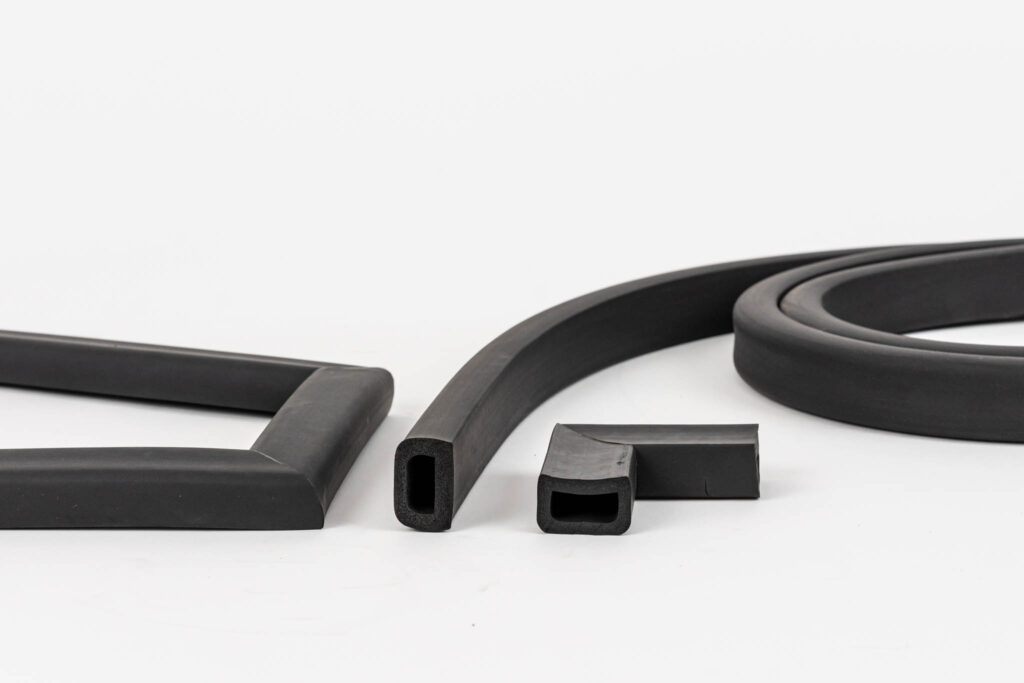
Vulcanised joining is another process used for joining together rubber extruded profiles into rings and mitred corners, using the same rubber material for the joints as the extrusion. This highly reliable and cost-effective joining process provides an almost invisible join and is commonly used to create products such as tubing, O-rings, and square/rectangle profiles in low volumes.

Your Extrusion Needs

Talk to us today about your extrusion needs. As specialists in rubber extrusion and conversion, our sales team are always on hand to talk you through the best suited materials for extrusion, along with the manufacturing processes to provide the best product to suit your application. Please contact us by calling 0121 773 8494 and we will be happy to be of assistance.